
Edge AI, TinyML and Computer Vision
TinyML on microcontrollers (TensorFlow Lite, Edge Impulse), computer vision on NVIDIA Jetson and Google Coral. Anomaly detection and object recognition — on the device, without the cloud.
Typical project:Predictive maintenance sensor + Edge ML· 8–16 weeks
Project
Tell us briefly about the project: what you want to build, which functions it needs, the rough timeframe. If we have done something similar we will send an example.
TinyML on STM32/ESP32, TensorFlow Lite Micro, Edge Impulse, ONNX. NVIDIA Jetson, Coral Edge TPU integration. Anomaly detection, keyword spotting, object classification for embedded.
The point of edge AI is to put the model on the device rather than in the cloud. That buys three things: latency drops to milliseconds, the system keeps working when the connection dies, and the data never leaves the device.
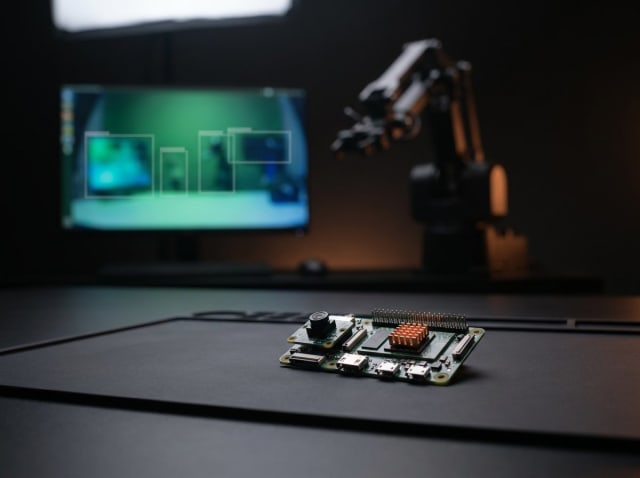
At microcontroller level we work with TensorFlow Lite Micro and Edge Impulse — anomaly detection in vibration, sound and motion data belongs here. For heavier work (object recognition, counting, reading) we use edge platforms such as NVIDIA Jetson or Google Coral.
In this field the real work is not choosing a model but collecting the data. Without samples gathered in real conditions a model works in the lab and fails in the field. So a project usually starts with a data collection phase.
How we work
What this area covers
- TensorFlow Lite Micro on STM32/ESP32
- Edge Impulse pipeline (data → model → deploy)
- NVIDIA Jetson Nano/Orin computer vision
- Coral Edge TPU integration
- Predictive maintenance (vibration, acoustic)
- Keyword spotting, gesture recognition
What you receive
- Data collection plan and the collected dataset
- Trained model and accuracy report
- Inference code running on the device
- Power and latency measurements
- Retraining procedure
- Device configuration and deployment documentation
Technologies we work with
From concept to production
- 01
Consultation and Requirements Analysis
We jointly define the project's goals, functional requirements, and budget/timeline constraints. NDA signed if needed.
- 02
Architecture and Schematic Design
System architecture, part selection, schematic drafted. Initial BOM and PCB block diagram agreed upon.
- 03
PCB Layout and Firmware
PCB design (KiCad/Altium), signal integrity, EMC checks. Firmware developed in parallel. Interim reviews.
- 04
Prototype and Testing
First PCB batch assembled and lab-tested. Validation with firmware. Required adjustments.
- 05
Production and Support
DFM optimization for mass production. Documentation, user manual, long-term technical support.
Frequently asked questions
Other engineering areas
Have an idea? Let's talk
Small prototype, medium-scale R&D, or long-term technical support — regardless of your project size, I respond within 48 hours.