
Automotive ECU Repair in Baku
Car ECU repair in Baku — circuit board repair for engine control units, ABS, BCM, airbag modules, instrument clusters and transmission control units: fault codes, no communication and water damage.
Order
Send the make and model and describe the fault briefly. A video helps most — film the fault. Clear photos of the board help too.
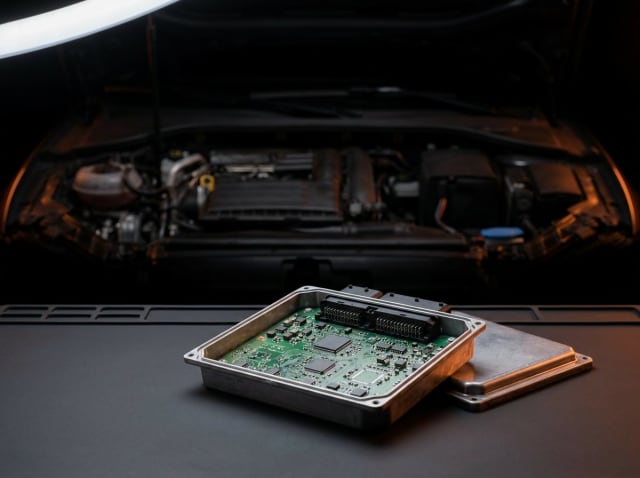
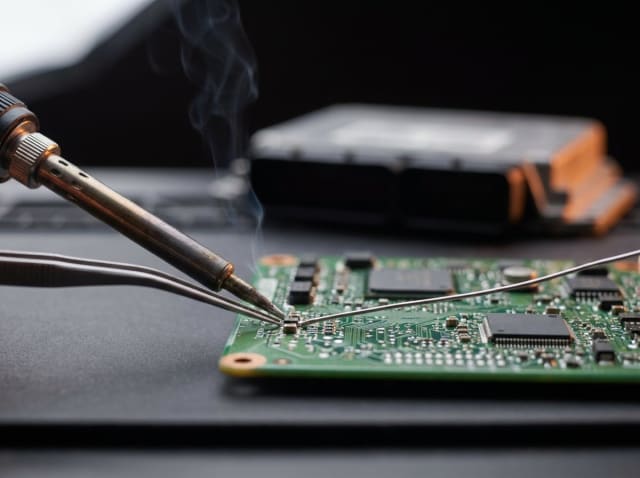
Automotive electronics repair: ECU (engine control unit), ABS module, BCM, airbag module, instrument cluster and transmission control unit (TCU). Component-level circuit board repair, EEPROM read/write and restoration of factory firmware.
How we work
Not every device can be repaired
Sometimes restoration is not possible: the chip is discontinued and no spare can be sourced, no donor board is available, the board is severely damaged by fire or liquid, or earlier repair attempts have left it beyond recovery. In such cases we explain the situation plainly and, where possible, suggest an alternative.
In ECU repair our work is at board level: we find and restore the fault and return the factory firmware. We do not do chip tuning — software changes to raise engine power are outside what we do.
Alongside ECUs we take in ABS modules, BCMs, airbag modules, instrument clusters and transmission control units — in all of them the work is circuit board repair rather than buying a whole unit. Typical cases: the engine faults and cannot be read, the ABS light will not go out, cluster segments flicker, the TCU will not manage gear changes.
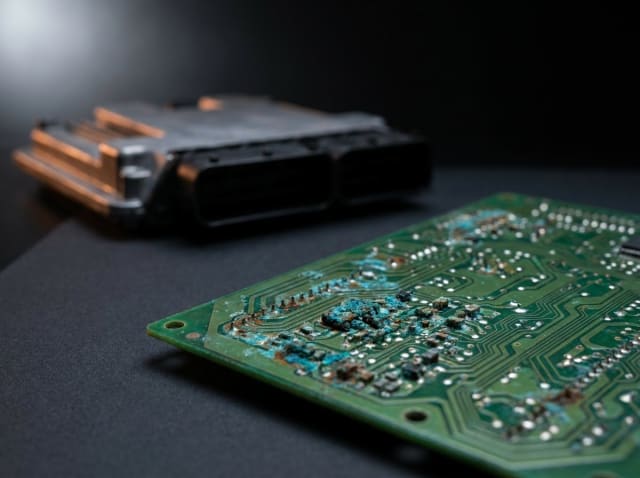
Two causes dominate this group: water and voltage. When moisture gets into a unit, corrosion spreads to the traces and connector pins; a reversed battery or a surge burns the driver chips. In both cases coming in early improves the outcome considerably.
Devices we repair
Common faults we repair
- The ECU throws a fault code, the diagnostic tool cannot read it
- The engine will not start, the ECU does not respond
- The ABS light stays on, a sensor fault persists
- The transmission control unit (TCU) will not manage gear changes
- Segments on the instrument cluster flicker
- The airbag module holds a fault, the light is on
- The BCM will not control the lights or central locking
- An injector or coil driver chip has burnt out
- Water has entered the unit, there is corrosion
- EEPROM data is lost, the key is not recognised
- Connector pins are oxidised, contact is lost
- Communication drops on the CAN bus
Typical causes of failure
- A reversed battery connection or a voltage surge
- Water and moisture entering the unit, causing corrosion
- A driver chip burnt by a short in the injector or coil circuit
- Cracked solder joints from vibration
- Loss of data in the EEPROM memory chip
- Oxidised connector pins and lost contact
- Miswiring during aftermarket alarm or audio installation
- Voltage dropping too far during repeated start attempts
Brands and platforms we work with
How the repair works
- 01
Enquiry and first contact
Tell us about the fault on WhatsApp or Telegram. We review what you send and let you know whether the device fits the work we take on.
- 02
Acceptance and diagnostics
If we can take the device on, we confirm it in advance — do not ship it before you have our confirmation. Once it reaches the lab, diagnostics are completed within 48 hours (two working days).
- 03
Estimate and approval
You receive a report covering the cause of the fault, the estimated cost, spare-part availability and the timeline. Work begins only after you approve it.
- 04
Testing and handover
After the repair the device runs a minimum 24-hour load test. Once it proves stable in normal operation, we report the result and hand it over.
Diagnostics and pricing
Diagnostics is paid work — 10–50 AZN depending on the complexity of the board. If you have us carry out the repair, that amount is deducted from the final price. An exact repair price is given only after diagnostics and is agreed with you before any work starts.
More about the diagnostic feeFrequently asked questions
Other repair areas
Request a repair
Message us on WhatsApp or Telegram with the BRAND and MODEL of the device and describe the fault in as much detail as you can. A VIDEO helps most: record the fault and explain in your own words what happens. Also send clear photos of the device and, if accessible, of the circuit board from several angles. The more detail you provide, the faster and more accurate our answer.