Getting a robot to finish an obstacle course takes more than a walking controller. It must perceive obstacles, stay balanced, and adapt its gait when the path changes. In NVIDIA’s stack this is done by chaining AI-assisted planning, asset creation, physics simulation and large-scale reinforcement learning (RL).
Planning the course with AI agents
On RTX Spark, the AI agents Hermes and NVIDIA Nemotron 3.5 Bolt turn a natural-language prompt into a detailed project plan for Microduck. The plan covers:
- reviewing the Microduck repo and docs,
- defining obstacle layout, dimensions and clearances,
- specifying navigation and locomotion challenges.
A local image-generation model produces a photorealistic concept image of the course. Hermes and Nemotron analyze this image and build an asset inventory: each object gets an ID, description and cropped reference. Visible vs. assumed details are explicitly recorded. Hermes then bundles the plan, concept, inventory and instructions into a handoff package and delegates it to the Astra agent.
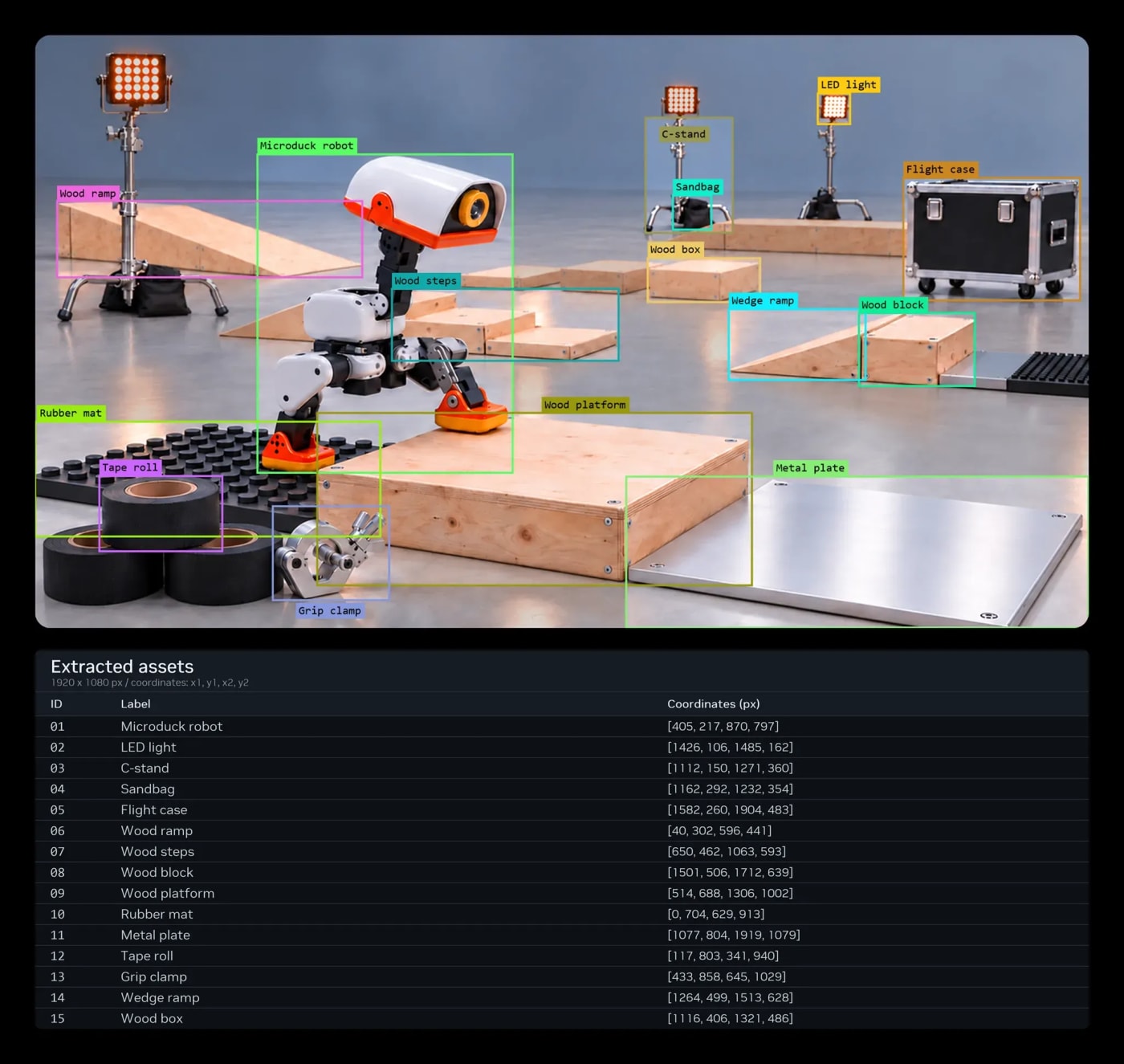
Illustration of the Microduck robot with labeled assets used to build simulated obstacle courses. — Image: NVIDIA
Creating assets and assembling the Isaac Sim environment
Astra uses cloud image editing to clean up the crops and generate higher-resolution references, checking that shape, proportions and colors still match the original concept. Unknown dimensions and hidden surfaces are logged as modeling assumptions.
Geometry is modeled in FreeCAD, detailed and textured in Blender, and exported as editable models plus OpenUSD assets. You can also pull ready-made USDs from the free SimReady Central Library to reduce asset work. These assets become the building blocks of Microduck’s training course.
Astra then assembles the obstacle course in NVIDIA Isaac Sim. Here:
- Microduck’s links, joints and actuators define its articulated body,
- the Newton GPU-accelerated physics engine simulates motion and balance,
- Omniverse RTX rendering provides simulated sensor data (for example, head-camera depth).
The result is a full RL environment: a robot that can act, an obstacle course it can interact with, and feedback signals from success, falls and collisions.
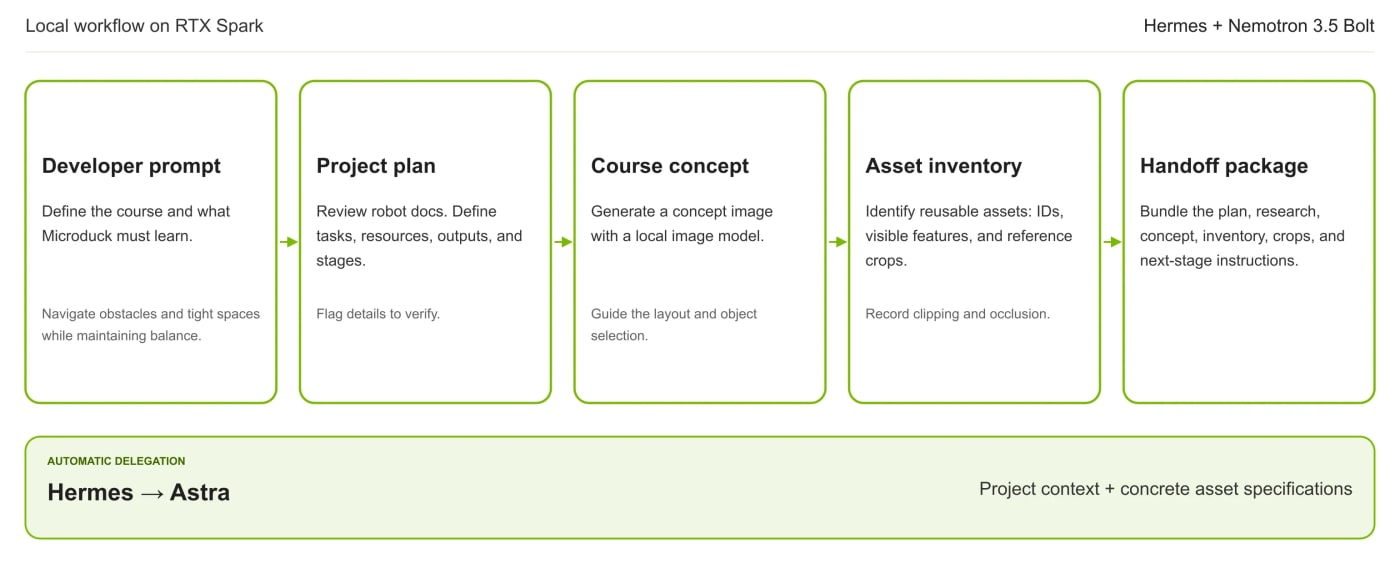
Workflow diagram of AI agent stages on RTX Spark for robot simulation environment development. — Image: NVIDIA
Training and evaluating the locomotion policy in Isaac Lab
With the environment ready, NVIDIA Isaac Lab trains and evaluates policies at scale by running thousands of Microduck simulations in parallel. For each task you define:
- observations (depth images, robot state),
- actions (joint torques or positions),
- rewards (forward progress, stability, penalties for falls).
Newton simulates the loop observations → policy actions → motion → new observations. In the example experiment, Microduck learns to traverse curved ramps and uneven terrain while avoiding falls. A locomotion policy pretrained in the base Microduck environment is further adapted on ramps and obstacles using 4,096 parallel environments on an NVIDIA RTX PRO 6000 Blackwell Workstation Edition GPU.
After training, you validate the frozen policy locally in Isaac Sim on RTX Spark: Microduck receives simulated observations, predicts actions, moves through the course and reacts to the updated scene. You log course completions, falls, collisions and stalls, and use these metrics plus rollout videos to refine the environment or reward design.
Preparing for deployment on the real Microduck
To transfer the policy to hardware you must narrow the sim-to-real gap. Isaac Lab’s Better Actuator Models (BAM) capture servo response, command latency, mechanical backlash and voltage drops from shared batteries. Domain randomization varies physical parameters and sensor noise within realistic ranges so the policy learns to handle discrepancies.
Once the policy is robust in simulation, it can be deployed to Microduck’s onboard computer and iteratively refined with real-world tests, guided by the same plan–simulate–train–evaluate workflow used in sim.
Source: developer.nvidia.com · Cover image: NVIDIA