Architect Labs, a startup based in Palo Alto, has unveiled Frostbite, a general‑purpose CPU architecture that it says was discovered, designed and verified largely by AI agents. According to the company, a four‑tile Frostbite cluster in 7 nm pre‑silicon simulations delivers 4.59× higher performance per watt and 8.77× higher performance per area than a similarly sized, “silicon‑proven” dual‑issue, in‑order core. The reference core is not named for legal reasons, and no Frostbite silicon has been fabricated yet.
Interaction nets instead of shared state
Frostbite is built around interaction nets, a computation model from 1990. Instead of a program mutating shared variables in memory, the program becomes a graph of nodes, and computation happens by rewriting connected node pairs.
Key properties:
- Each rewrite touches only a small local part of the graph;
- Each node has one principal port, so active pairs never overlap and can run in any order or all at once with the same result;
- The system is linear: every value is used exactly once, so there is no shared mutable state.
Architect Labs calls this “multithreading for free”: parallelism comes directly from the program structure, with no threads, locks, or out‑of‑order machinery needed to rediscover it. Each Frostbite tile has its own local memory, reducing the need for large cache hierarchies and complex coherence protocols.
As an example, the team cites a 5×5 board with five queens placed so none attack each other. A conventional program explores boards one by one. As an interaction net, the search becomes 3,183 small interactions, with the longest dependency chain only 262 steps; on average about 12 interactions are ready in parallel at each step, without rewriting the algorithm.
How the AI found the architecture
Architect Labs says it started Frostbite with “zero architectural priors.” Human engineers first defined 25 workloads – including FFT, radix sort, LU, Kalman filter, PCA, finite‑element analysis and LZ4 decompression – that the chip should excel at. AI agents then read papers and benchmarks, built Python models, and compared architectural ideas before converging on a single concept.
The initial output was a 141‑page PDF describing a programming model, runtime and high‑level blocks. Once the first RTL generation was produced, that document was discarded because many estimates turned out to be physically unrealistic.
From there, the team abandoned natural‑language specs and moved to a custom formal specification language called ASL. ASL can be translated into the Lean proof checker, making the spec machine‑verifiable and limiting both bugs and “reward‑hacking” by agents.
Using ASL, the agents built Arcmodel, a full software model of the chip that runs roughly 200× faster than RTL simulation. Initially its power estimates were off by up to 250%, but an automated calibration loop tightened that to within 1–5% of circuit‑level results.
On top of Arcmodel, swarms of agents proposed microarchitectural changes in parallel. Each change was checked against the ASL spec, tried in the fast model, synthesized to RTL, and measured for power. In total, 58 ideas were explored, 37 kept. One emergent behavior not specified by humans was work stealing: an idle tile can take work from a neighbor, or go fully idle to save power.
Status and what’s next
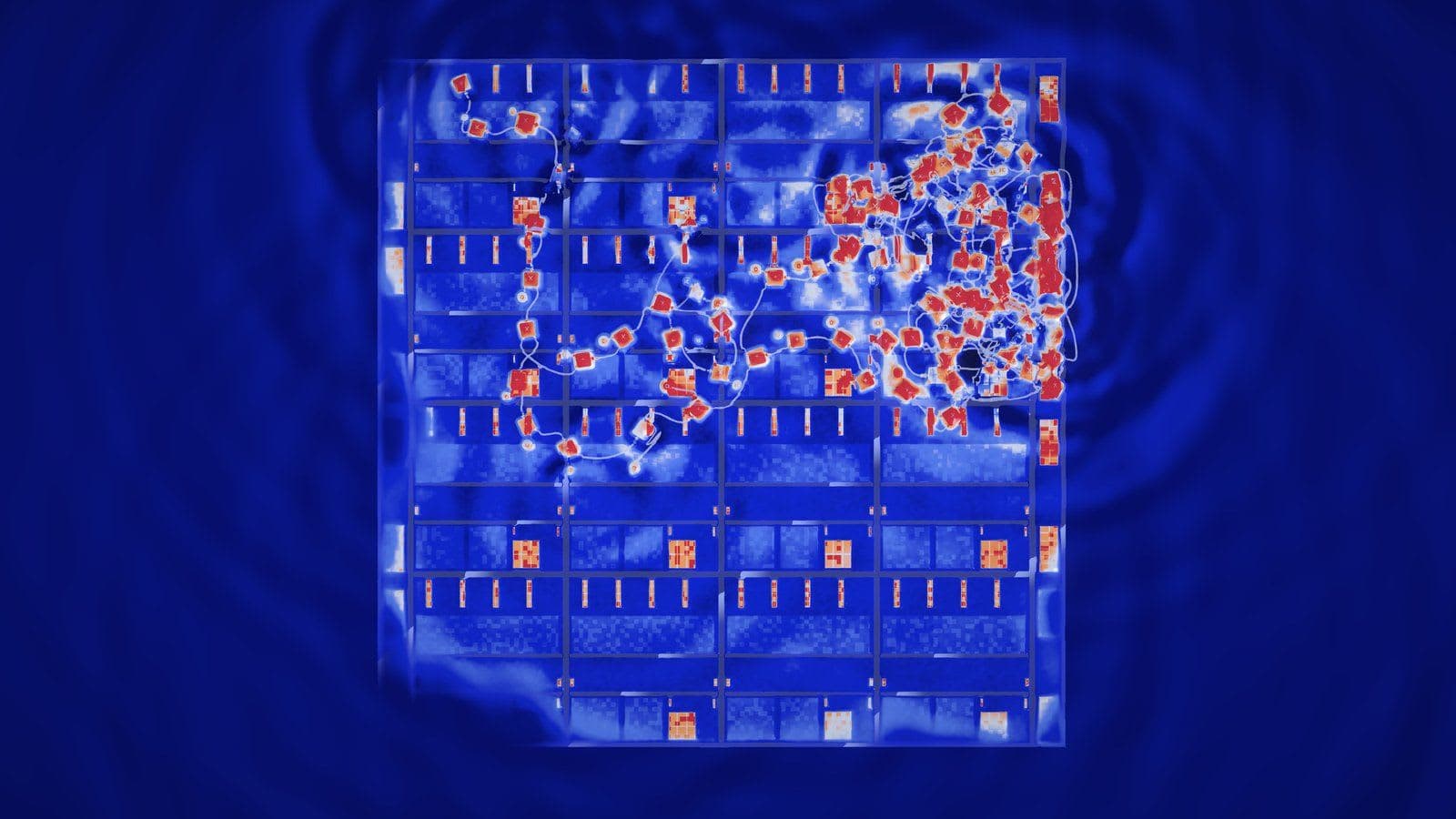
The current Frostbite layout uses 16 tiles connected by an on‑chip network and ultimately closed at 500 MHz after early synthesis hit 800 MHz. All results are still pre‑silicon.
Architect Labs plans to:
- Publish more benchmarks, including SPEC and PARSEC;
- Compare Frostbite meshes against multicore and wider out‑of‑order CPUs with large caches;
- Release an FPGA‑hosted playground and a preliminary OS so developers can run their own code on Frostbite;
- Eventually open up the RTL and instruction set.
For hardware designers and embedded engineers, Frostbite is less about one specific core and more about the possibility that future CPU, accelerator and networking chips could be co‑designed – or even discovered – by AI systems operating across compiler, ISA, microarchitecture and physical design.
Source: Architect Labs, Gündəm · tomshardware.com · Cover image: Architect Labs