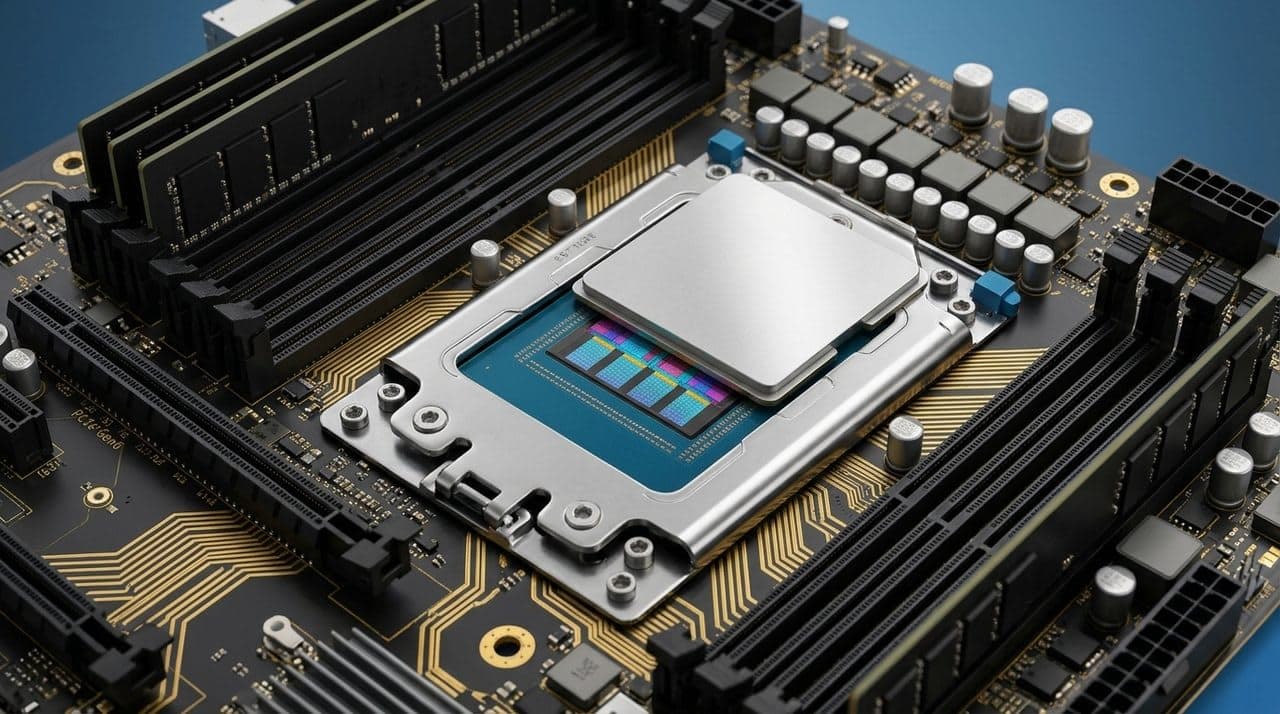
AMD’s new EPYC Embedded 9006 “Venice” family brings its latest Zen 6 server technology straight into the embedded world – and this time in lockstep with the mainstream EPYC 9006 launch. For the first time, embedded SKUs are no longer last in line, which says a lot about how strategic this segment has become for AMD.
SP7 platform and key specs
EPYC Embedded 9006 adopts the SP7 platform wholesale, delivering a major step up over SP5:
- Up to 256 cores / 512 threads (Zen 6 / Zen 6c)
- 2 nm process
- 16‑channel DDR5‑8000 and MRDIMM‑12800, up to 8 TB RAM
- 96 lanes PCIe Gen6 with CXL 3.1 support
- Peak power up to 600 W on top SKUs
Generation‑over‑generation, Embedded 9004 → 9005 → 9006 increases core counts, memory bandwidth and capacity, while moving from PCIe 5.0 to PCIe 6.0.
Long‑term embedded roadmap
AMD commits to at least 7 years of availability for EPYC Embedded 9006, with even longer support. Just as important, SP7 will be reused for the next generation “Florence” chips. Designs started today can later be upgraded to newer CPUs without a full platform re‑validation, which is critical in embedded markets with long lifecycles and costly certification.
Target applications: ATE, firewalls, storage
AMD is aiming this generation at three main classes of systems:
- Automatic Test Equipment (ATE) for next‑gen DDR5, MRDIMM and PCIe Gen6/CXL components
- High‑end firewalls, where AI‑driven traffic and complex policies are increasingly CPU‑bound
- Enterprise storage controllers, especially boxes that want to fully exploit PCIe Gen6 SSDs without external switches
There is one trade‑off: compared to SP5’s 128 lanes of PCIe Gen5, SP7 offers 96 lanes of PCIe Gen6 – fewer lanes, but significantly higher per‑lane bandwidth.
The first chip, the 128‑core EPYC Embedded 9756, is shipping this month, with five more SKUs following by the end of December.
Source: ServeTheHome