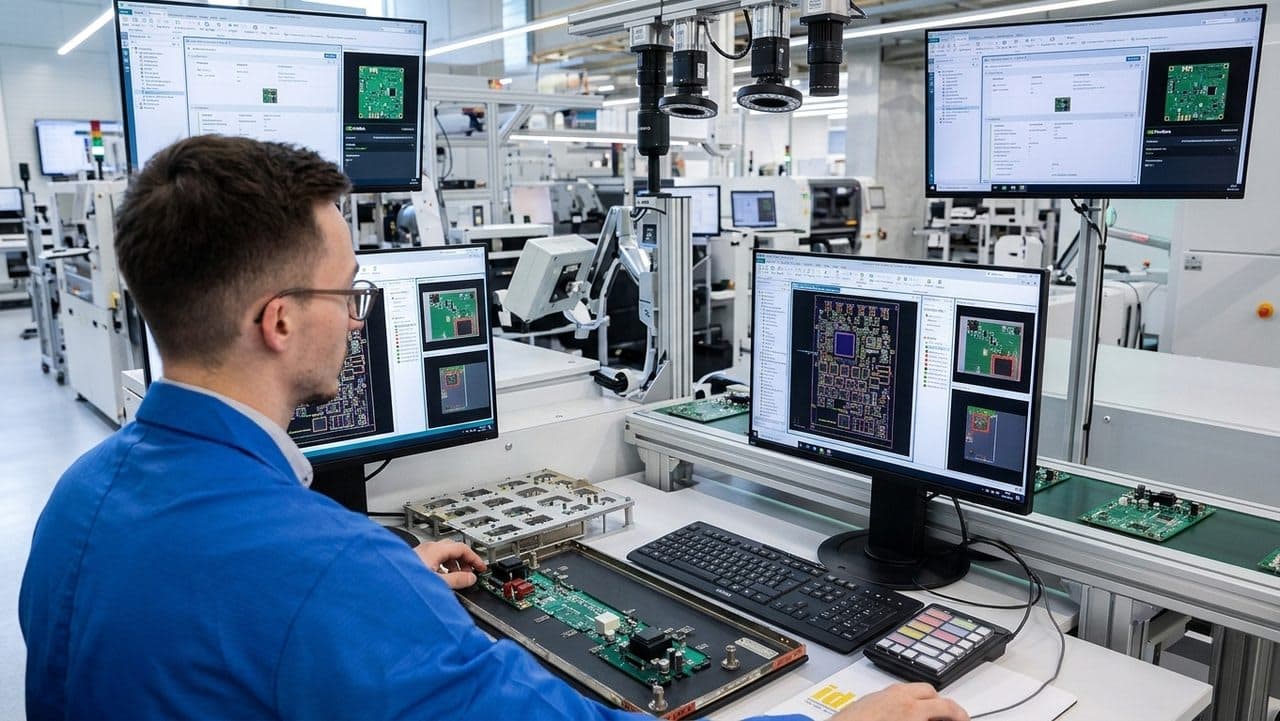
Siemens and Nvidia are building a new quality-control system for printed circuit boards that prepares AOI (automated optical inspection) long before the first physical board exists.
The core idea is a digital twin of the assembled PCB. Siemens Teamcenter provides design data, the BOM and component placement. Process Preparation X validates and merges this information to create a full digital model of the populated board. From this, a virtual reference – the so‑called “golden board” – is generated, which real products on the line will later be compared against.

Stack of green printed circuit boards prepared for inspection or assembly — Image: JayHand / Wikimedia Commons, CC BY-SA 3.0
On top of that, Nvidia Cosmos is used to generate photorealistic synthetic images of PCBs, including various possible manufacturing defects. These datasets are then used to pre‑train and calibrate AOI systems, which rely on cameras and image-processing algorithms. In practice, the inspection equipment learns to recognize potential defects before any real hardware reaches the line.
From setup to adaptive production
The AI system also assists after ramp‑up. When AOI flags a suspicious area, an additional AI-based verification module analyzes it and decides whether it is a real defect or a false positive. Siemens targets a 40% reduction in false alarms and a noticeable increase in first‑pass yield.
The solution is being demonstrated at the Siemens Electronics Factory Erlangen in Germany, used as a testbed for highly adaptive production. Siemens expects that, with this technology, the plant will be able to change production processes several times per week without stopping the line.
Overall, the company claims up to 85% less manual engineering work to prepare AOI programs and more than a 5% increase in boards passing inspection on the first try – still target figures, but promising for faster launches of new PCB variants without waiting for physical samples.
Source: iXBT