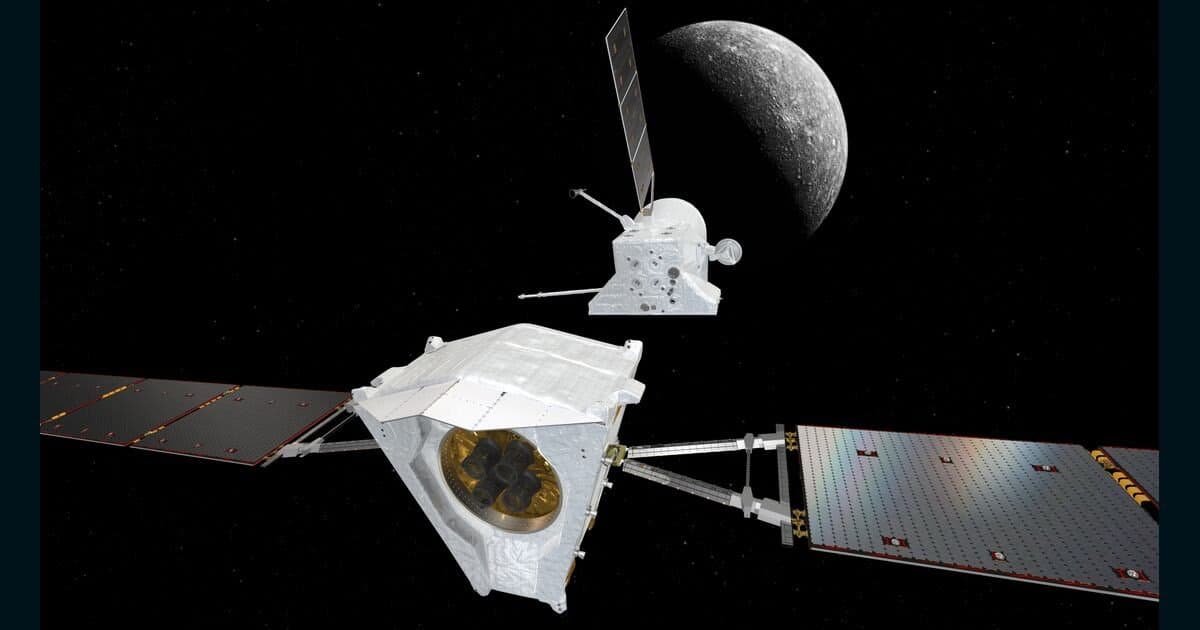
The joint BepiColombo mission by ESA and JAXA is about to reach its most critical milestone: entering orbit around Mercury after an eight‑year interplanetary cruise. Launched in October 2018, the spacecraft couldn’t simply “fall” towards the Sun; instead it followed a long, looping trajectory with multiple fly-bys of Venus and Mercury, using their gravity to gradually reshape its path and bleed off energy.
Now the stack is preparing for a complex arrival sequence. On 3 September 2026, ESA’s Mercury Transfer Module (MTM) – the element that has provided power and propulsion during the cruise – will separate from the two science orbiters. The entire operation will be run from ESA’s European Space Operations Centre (ESOC) in Darmstadt, Germany, and streamed live.
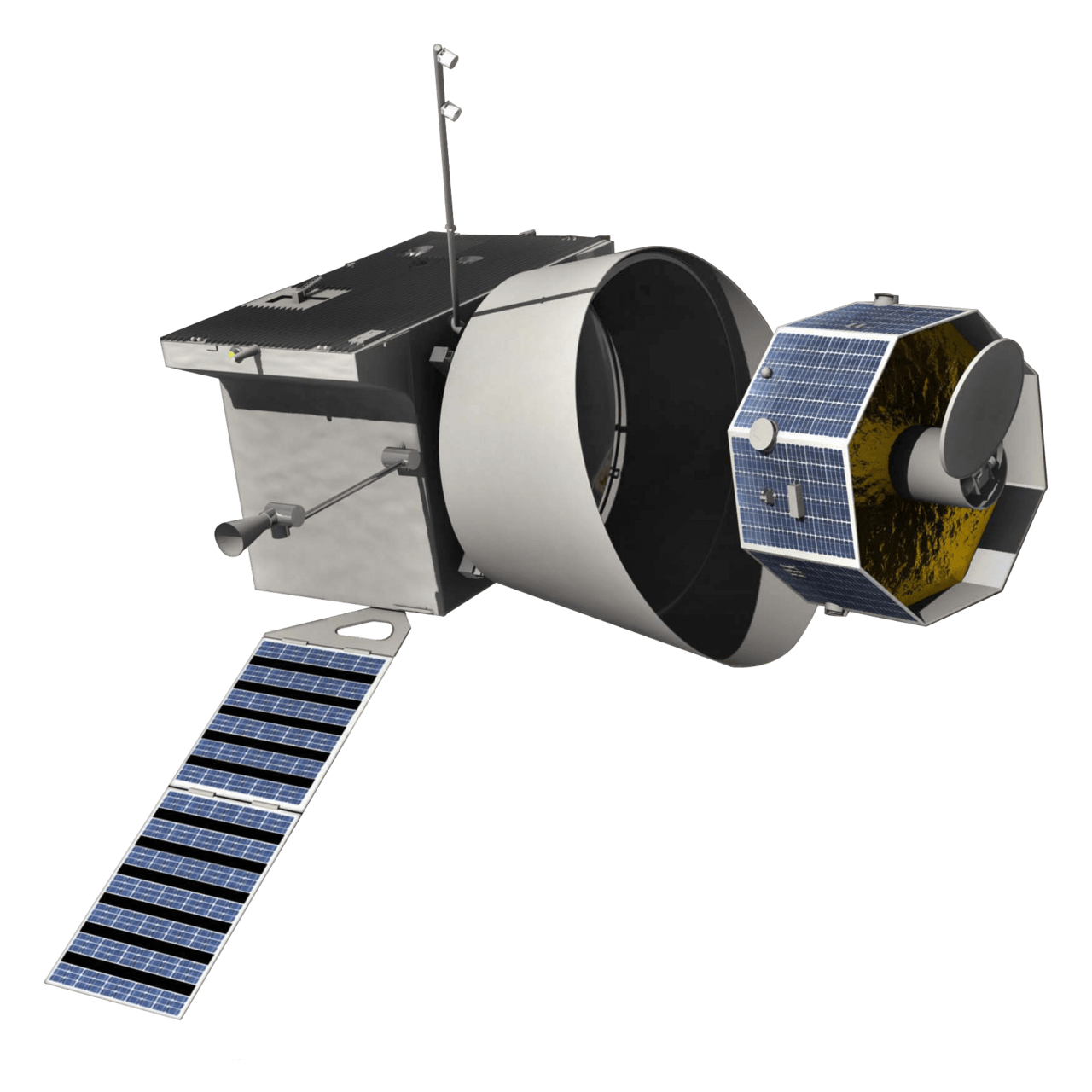
Rendering of the ESA/JAXA BepiColombo spacecraft with MTM and the two orbiters — Image: National Aeronautics and Space Administration (NASA) / Wikimedia Commons, Public domain
From cruise stack to dual science orbiters
Once MTM has separated, ESA’s Mercury Planetary Orbiter (MPO) and JAXA’s Mercury Magnetospheric Orbiter (Mio) will jointly enter orbit around Mercury later in 2026. After that, they will split:
- Mio will settle into a higher polar orbit to study Mercury’s magnetosphere;
- MPO will manoeuvre into a lower polar orbit focused on surface geology, the tenuous exosphere and the planet’s magnetic field.
Science operations for both spacecraft are scheduled to begin in April 2027.
A short but intense science window
According to mission plans, BepiColombo’s primary science phase will last one Earth year, a little over four Mercury years. If fuel and thermal conditions allow, it may be extended by another year, but the combination of limited propellant and extreme temperatures close to the Sun will ultimately end the mission.
For space and engineering enthusiasts, ESA’s live coverage from the main control room offers a rare, unfiltered look at one of the most demanding deep-space operations Europe has ever flown.
Source: European Space Agency, Gündəm · newscientist.com · Cover image: European Space Agency