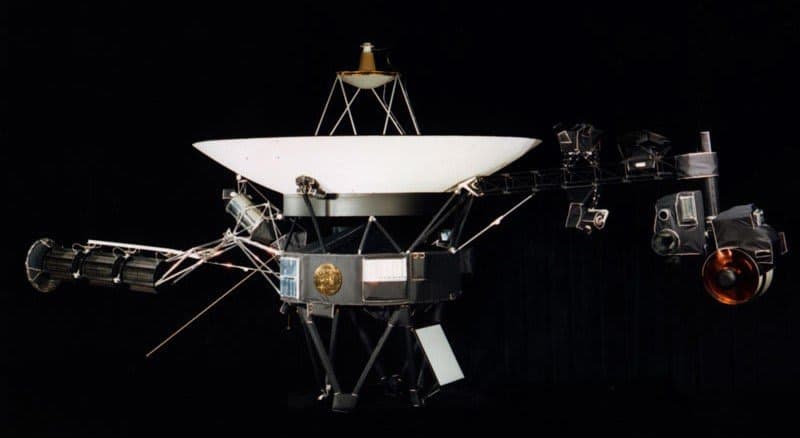
NASA has confirmed that Voyager 1 has reached a historic distance of one light-day from Earth — about 16.1 billion miles (25.9 billion km) — the farthest any human-made object has ever traveled. At the same time, the veteran probe has run into a familiar problem: it has stopped sending back science and engineering data.
Carrier signal, but no data
On Nov. 14, a Deep Space Network antenna in Canberra, Australia, locked onto Voyager 1 and received a carrier signal, the radio tone used to carry telemetry. That proves the spacecraft is:
- still powered and pointed at Earth,
- using its Attitude and Articulation Control computer correctly,
- and has a working high‑gain antenna and transmitter.
However, no readable data are modulated onto that carrier. According to NASA, the likely culprit is the onboard computer that collects data from subsystems and science instruments and formats it for downlink.
Because radio waves now take 24 hours to reach the probe and another 24 hours for a reply, every test cycle takes two days. Troubleshooting even a “small” anomaly can stretch over weeks.
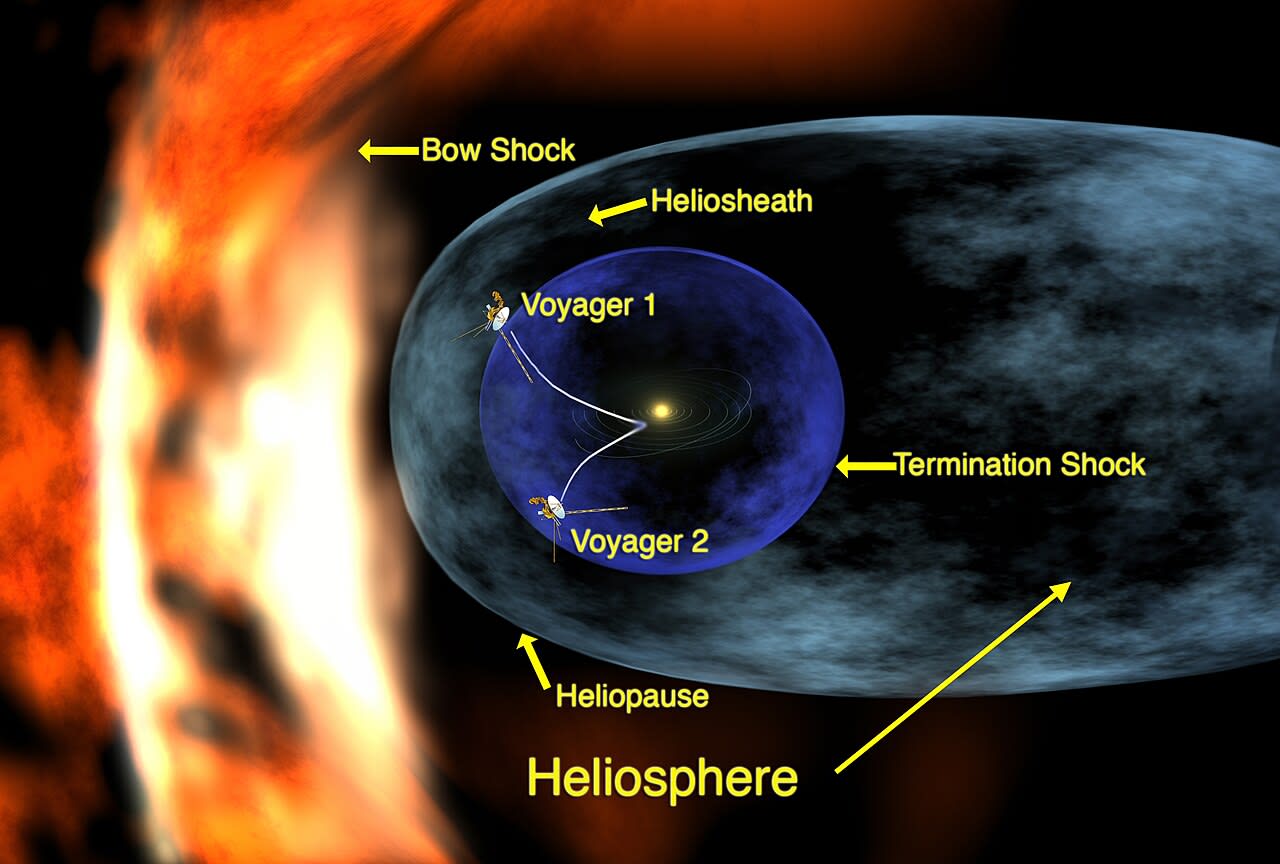
Trajectories of Voyager 1 and Voyager 2 as they travel beyond the heliosphere. — Image: NASA/Walt Feimer / Wikimedia Commons, Public domain
Old hardware, new anomaly
Voyager 1 experienced a very similar issue in late 2023, which engineers finally resolved in June 2024. That fix also involved reconfiguring the probe’s aging computers, and the team is following a comparable playbook now. They are also checking for any link to a brief 48‑hour loss of contact in October.
If they succeed, Voyager 1 will keep returning measurements from its two remaining instruments:
- a magnetometer probing interstellar magnetic fields,
- a plasma wave detector sensing charged particles in the interstellar medium.
To stretch the power budget, NASA has already shut down several other instruments and reconfigured loads in a “Big Bang” power maneuver, aiming to keep the spacecraft alive at least through 2027.
Eventually, engineering failures and dwindling power will silence Voyager 1’s transmitters. The probe will then continue its silent journey through interstellar space, carrying the Golden Record of sounds and images from Earth — a relic of the mission that reshaped our view of the outer Solar System and beyond.
Source: NASA, Gündəm · livescience.com · Cover image: NASA