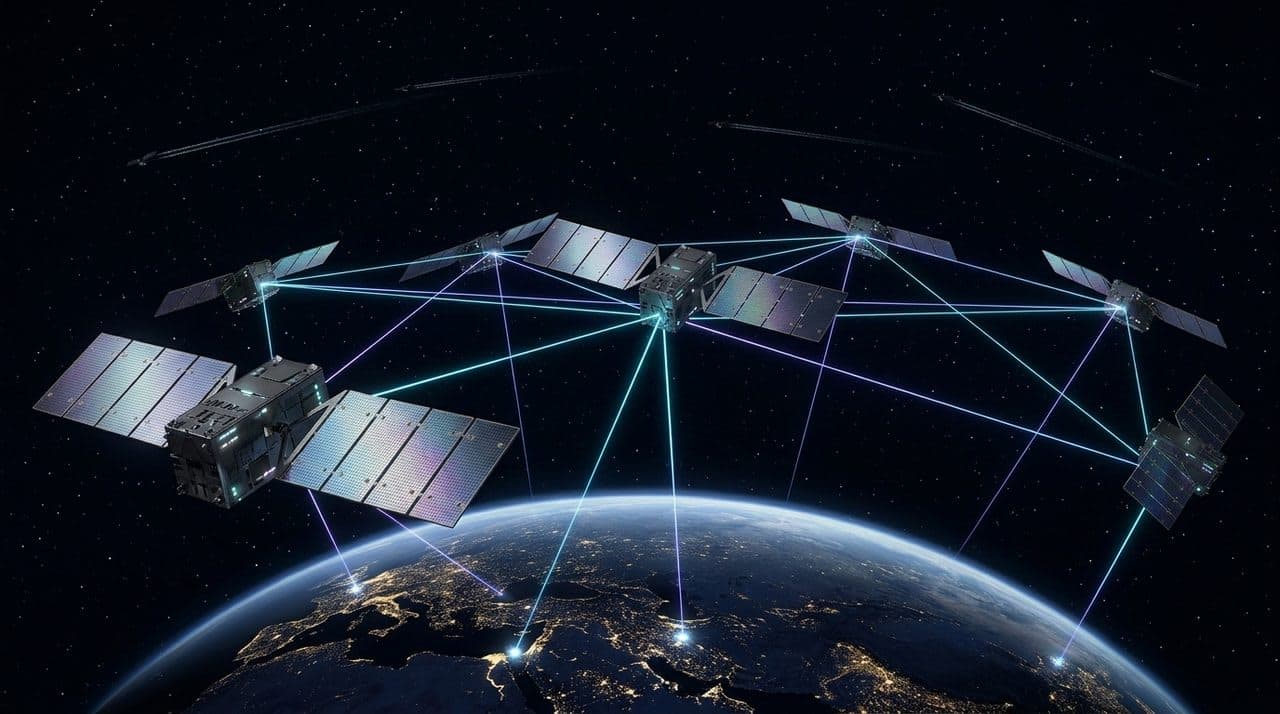
The US Federal Communications Commission (FCC) has granted SpaceX a landmark license for its Starmind project, a plan to deploy up to one million satellites in low Earth orbit to act as AI-oriented orbital data centers.
What Starmind aims to do
SpaceX wants Starmind satellites to:
- Harvest power from the Sun via large solar arrays,
- Perform AI computation directly in orbit, close to the data sources,
- Hand results off to the existing Starlink constellation, which will relay them back to Earth.
Like Starlink, Starmind will operate in low Earth orbit (LEO) at around 500–2,000 km altitude. Under the FCC license, deployment must start no later than November 2033. SpaceX must have 10% of the constellation in orbit by 2035 and 50% by 2038. The company is already talking about launching the first Starmind satellite next year.
Potential benefits and hard problems
Orbital data centers are pitched as a more energy- and water-efficient alternative to terrestrial facilities, which consume huge amounts of power and cooling water and are increasingly unwelcome near residential areas.
However, several technical and environmental issues remain:
- High-capacity ground-to-orbit laser links are still not mature enough to handle the expected data volumes reliably.
- Launching and operating massive constellations is expensive and increases space debris risk.
- The growing number of LEO objects raises the chance of collisions and cascading damage.
Backlash from astronomers and rivals
The American Astronomical Society (AAS) says the constellation would "significantly undermine" decades of investment in observatories and harm both professional and public views of the night sky, as larger and more numerous satellites would appear as very bright streaks for longer periods.
Amazon has dismissed Starmind as a "lofty ambition rather than a real plan", while environmental advocates warn that a drastic expansion of satellites will have direct impacts on everyday life and the planet’s long-term health.
Despite the criticism, the FCC calls Starmind a bold step for the infrastructure needed to power America’s "super intelligence" economy, and SpaceX is pushing ahead with its orbital compute vision.
Source: Gündəm · bbc.com