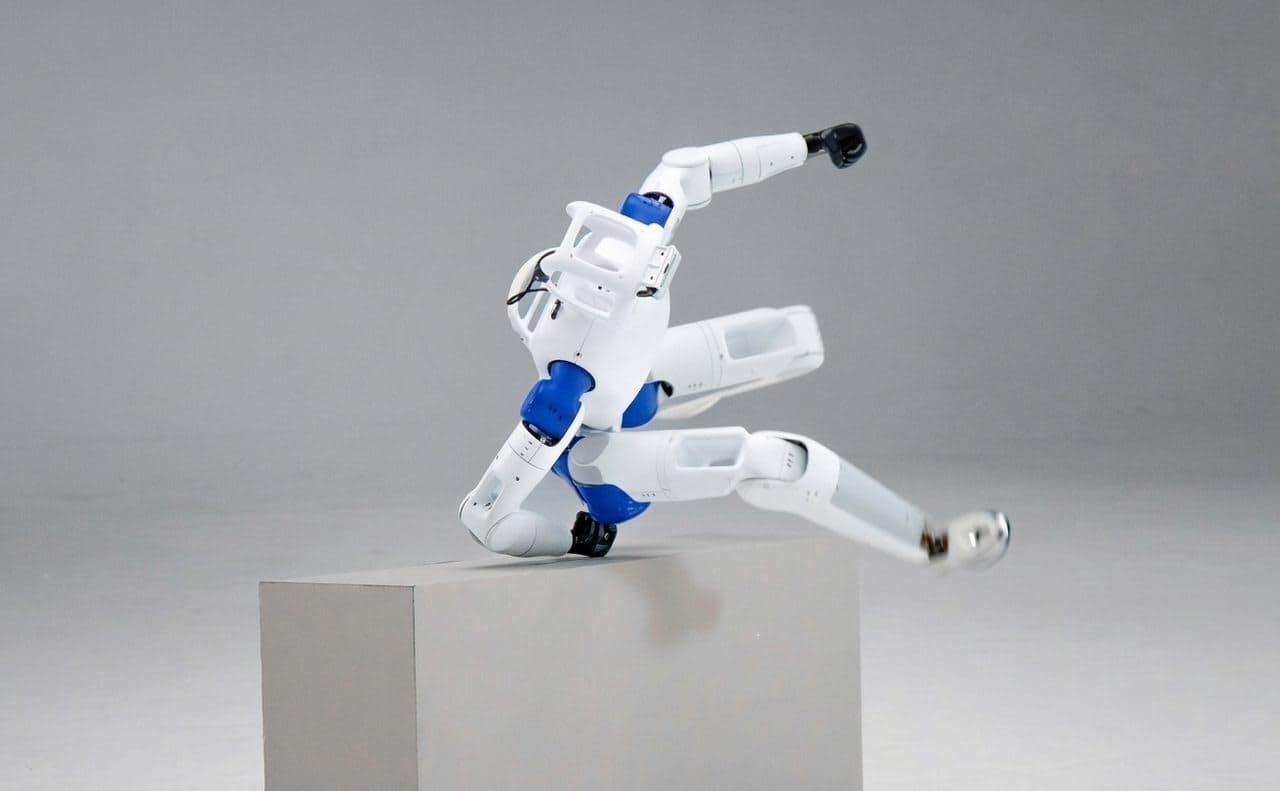
RoboParty has unveiled RP1, a full‑stack open‑source humanoid robot aimed squarely at embodied AI research. The platform ships in a standard 24‑DoF version (about 1.3 m tall) and a 30‑DoF Pro version for more advanced work.
From simulation to real hardware
RP1 is built as an end‑to‑end research platform. Its open toolchain covers:
- data collection on the real robot
- training in simulation
- deployment and experimental validation on physical hardware
Researchers can plug in their own control policies and embodied AI models, carry them through sim‑to‑real, and debug issues across the full stack.
Out of the box, RP1 supports core motor capabilities:
- continuous walking
- disturbance recovery
- getting up after falls
- human motion tracking
This baseline frees teams from repeatedly re‑implementing low‑level locomotion and balance.
Whole-body control and AI stack
RP1 implements whole‑body control (WBC), coordinating arms, torso and legs for dynamic motion tracking and posture adjustment. Supporting tools include:
- VR teleoperation
- data logging and playback
- motion retargeting
The robot is integrated with RoboParty’s in‑house PartyOS embodied AI system, the UFO unsupervised reinforcement learning framework, and MimicLite motion imitation. Together they support motor skill learning, control policy development and higher‑level applications.
The Pro variant adds a 2‑DoF neck and two 7‑DoF arms, enabling research in end‑to‑end policies, human‑robot interaction and rich data collection. DoF counts exclude the robot’s dexterous hands; interchangeable head modules and wrist end effectors support different setups, including the RP Hand.
RoboParty is opening the RP1 mechanical design, ROMOMO joint actuator resources, low‑level drivers, control algorithms, firmware, SDKs, simulation environments and training tools. By exposing the full stack, the platform lets researchers trace failures back to the model, policy, actuator dynamics or mechanical structure and optimize them together on a shared open foundation.
Source: Auganix.org