STMicroelectronics is reshaping its STM32 line into a single, cross‑domain microcontroller platform that spans industrial, automotive, robotics and emerging physical AI systems. At the center of this move is a new STM32A family that pushes STM32 into automotive and other safety‑critical applications.
One STM32 platform, many markets
ST’s goal is to cut fragmentation: instead of separate MCU worlds for factory automation, cars and robots, the same architectural base is reused everywhere.
Key pillars of the unified STM32 platform:
- Arm Cortex‑M cores and shared architectural rules across STM32 families
- a common development stack built around STM32Cube and the wider Arm ecosystem
- shared manufacturing technologies: 40 nm Flash and 18 nm FD‑SOI with embedded non‑volatile memory (plus TSMC eNVM)
For embedded developers this means you can carry proven firmware, drivers and middleware from one domain to another with fewer rewrites, while still picking parts that match each project’s qualification, safety and lifecycle needs.
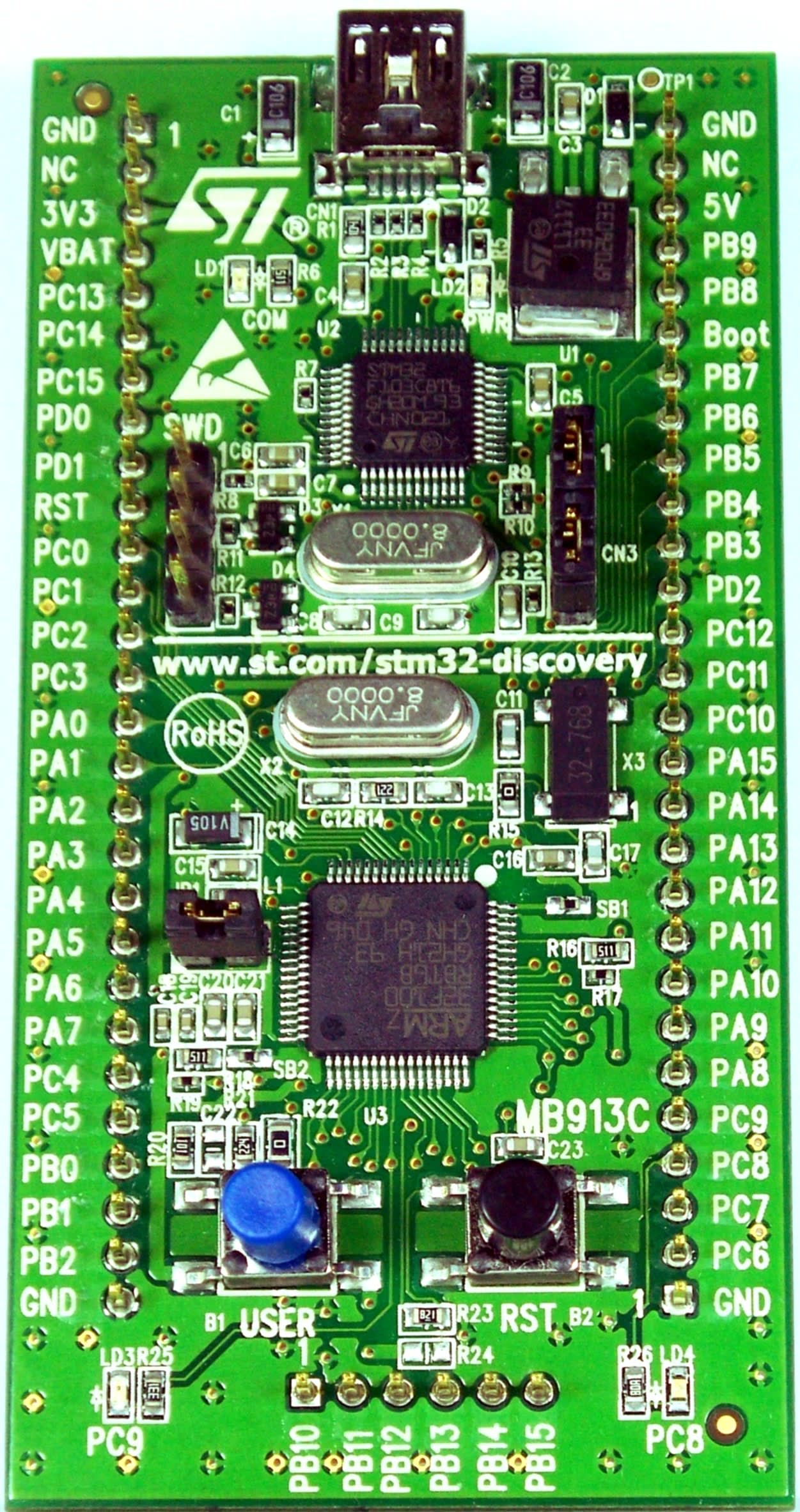
STM32 Discovery development board built around an STM32 microcontroller — Image: Viswesr / Wikimedia Commons, CC BY-SA 3.0
STM32A: bringing STM32 into automotive and high‑safety designs
The new STM32A family is ST’s bridge into high‑safety and automotive markets. The first three MCUs are already sampling, with broader availability targeted for 2027:
- STM32A4 – entry‑level automotive local control nodes and safety modules
- STM32A5 – mid‑range safety‑critical control in industrial automation, robotics, energy and automotive
- STM32A9 – safety‑critical multi‑domain control where real‑time behavior, low latency, Ethernet and deterministic networking are mandatory
For the maker and engineering community, the message is clear: code you prototype today on a standard STM32 Nucleo or Discovery board should migrate more easily to future industrial or automotive‑grade STM32A hardware.
Source: STMicroelectronics, EE Times Asia